Best Bluetooth Speakers for UTVs

A side-by-side at trail speed is a hostile place for music. Wind roar, knobby tires on gravel, and a motor that never fully shuts up swallow whatever a speaker puts out at driveway volume, and dust and creek water finish off anything not built for them. The right bar stays clamped to the cage and keeps playing anyway.

Spec sheets mislead. Speaker counts and peak wattage say little about whether you'll hear vocals at 30 mph; what counts is a real amp behind the drivers and a housing that seals. I check fit first — cages run roughly 1.5 to 2.25 inches, and a bar that doesn't match yours is a paperweight — then power, since some wire into the 12-volt bus and others want their own run. A remote you can work with gloves on matters more than you'd think.

We've lived with 12 of these for eight months, and the differences show up fast once you're moving. The ones that held their sound, their mounting, and their Bluetooth pairing are below.

The Best Bluetooth Speakers for UTVs

1

Ehaho 17-Inch UTV Sound Bar Best Overall
86 /100
TKZ Score Excellent

Key details

Peak Power
400 watts
Bar Length
17 inches
Weather Rating
IP66
Bluetooth
6.0 with Auracast
View on Amazon

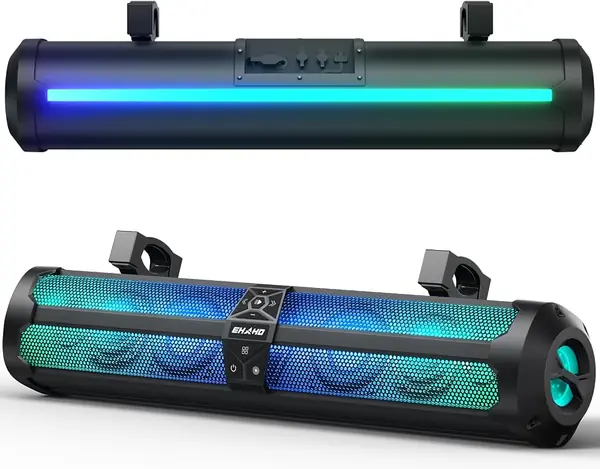
Auracast is what put this bar at the top of our list. The Bluetooth 6.0 radio here can share one stream across several compatible Ehaho bars, so the second machine in your group hears your playlist instead of losing it at the treeline, and that small feature quietly changes a group ride. The hardware underneath holds up: 400 watts of peak power into two 4-inch woofers and two tweeters, a 66-foot Bluetooth range that beats most of this group, and three EQ presets that do real work on a machine with a loud exhaust.

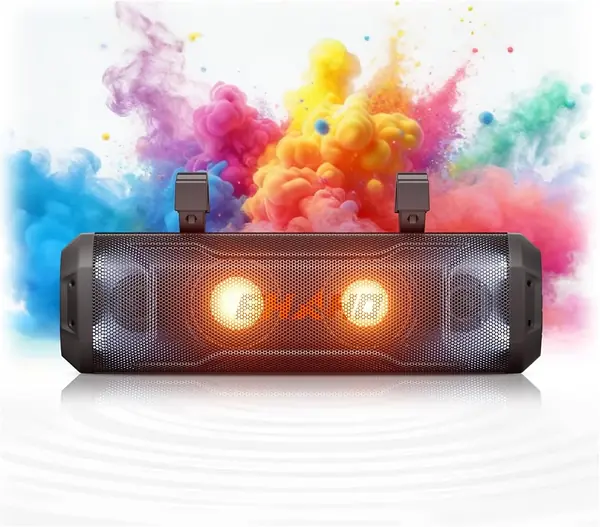
Install is a bracket job, not an afternoon. The bar is 6.8 pounds and 17 inches wide, so it tucks above the dash without eating headroom, and the mounting kit, fuse, and power lead all come in the box. IP66 is the rating that matters out here, covering dust, mud, and a hose-down after a wet ride, and the two-year warranty is one of the longer ones on this page. The RGB ring and its strobe modes are more fun at dusk than we expected, and they switch off when you want to be left alone.

What you do not get is subwoofer bass. Four-inch woofers give punch rather than depth, and parked beside the 28-inch KEMIMOTO the difference is plain. Underway it mostly disappears: at trail speed the wind and the engine claim the lowest octave before your ears do, and what is left is the part this bar does well.

Pros

  • Clear, room-filling sound over engine noise
  • Bracket install measured in minutes
  • IP66 sealing and a two-year warranty
  • Pairs several bars for group rides

Cons

  • Can stop powering on after a few weeks
  • Remote adjusts playback but cannot switch it on
Our verdict

We recommend it as the default UTV bar: clear sound over a running engine, a bracket install measured in minutes, and multi-bar pairing for group rides.
Check Latest Price
2

KEMIMOTO 28-Inch 6-Speaker Sound Bar Best for Deep Bass

85 /100
TKZ Score Excellent

Key details

Peak Power
160 watts
Bar Length
28 inches
Roll Bar Fit
1.5 to 2.25 inches
Drivers
4 woofers, 2 tweeters
View on Amazon

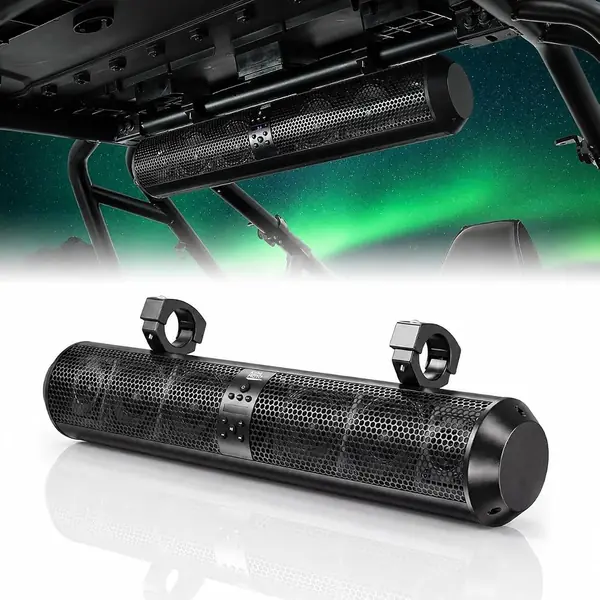
Four 4-inch subwoofers in a round aluminum tube is an odd way to build a sound bar, and it is the reason this one is our bass pick. Most bars this length run two small drivers and call it low end; KEMIMOTO fits four dedicated woofers plus two 1-inch soft-dome tweeters, driven by a Class A/B amplifier. On a machine with an exhaust note you are trying to drown, that extra cone area is the difference you notice in the first hundred yards.

The clamps open from 1.5 to 2.25 inches, which matters more than it sounds, because the fat tubes on a Can-Am or a newer RZR will not take a 1-to-2-inch bracket and this one closes around them. That range and the bass are why it earns a place here rather than simply being the biggest bar on the page. On a bare machine the install is genuinely quick; add a roof and a windshield and you are fishing cable through trim, so give yourself an afternoon and a fish tape rather than the twenty minutes it advertises.

Watch the hardware. The clamps are the weak point and can crack if you lean on them while tightening, so snug them by hand and stop. The remote is the piece most likely to give up first, and a replacement is not free. At 28 inches the bar also wants clear space above the dash; in a compact cab it will crowd your sightline, which is a fitment question rather than a sound one.

Pros

  • Four 4-inch woofers deliver genuine low end
  • Clamps span 1.5 to 2.25 inches for fat cages
  • Aluminum housing resists impact and heat
  • Three inputs including USB audio

Cons

  • Clamps can crack if over-tightened
  • 28-inch body needs clear space above the dash
Our verdict

Our pick when low end is the whole point: four dedicated 4-inch woofers and the widest cage fit here make it the bass-first choice in this group.

Check Latest Price
3

KEMIMOTO 6.5-Inch ATV Speaker System Best for ATVs and Quads

84 /100
TKZ Score Excellent

Key details

Peak Power
200 watts
Speaker Size
6.5 inches
Mounting
Ratchet strap
Water Resistance
Water repellent
View on Amazon

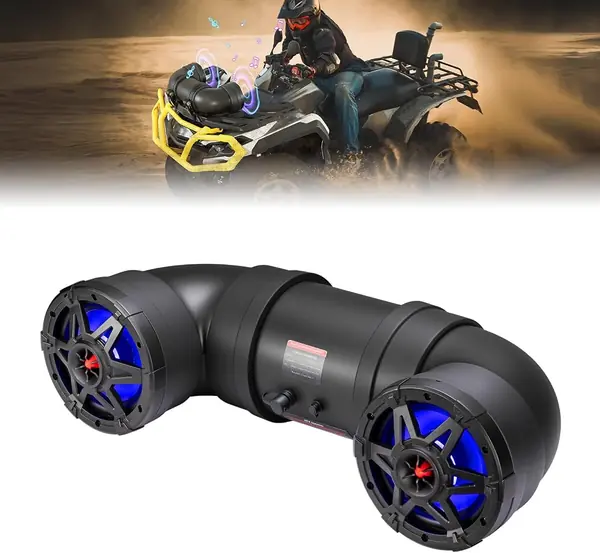
No cage, no drilling, no bracket hunt: two ratchet straps pull this unit down onto a rack or a frame rail, and that is the whole install. It is why we send ATV and quad riders here first, since a four-wheeler often has nothing round to clamp to. The speaker end is serious too, with two 6.5-inch drivers and a pair of 1-inch aluminum-diaphragm tweeters on 200 watts, and a top end that does not shred when you lean on the volume.

What we came back to is how much volume is left over at speed. It stays ahead of the engine where several bars here run out of headroom at full tilt, and the twenty lighting modes mean the evenings are covered. Bluetooth 5.3 pairs quickly and reconnects without a ritual, and the remote lives on the bars without needing to be aimed. Shaped like a conventional SxS sound bar and hung from straps, it covers both the quad and the side-by-side in one purchase.

Where it fits is the part to think through. The straps need a flat or square surface to pull against, so a bare tube bumper with nothing behind it is a poor host, and the unit is heavy enough that we re-checked strap tension after the first rough section. Seated properly it stays put; rushed, you will hear it move on washboard long before you see it.

Pros

  • Straps mount to racks and frames, no cage needed
  • 6.5-inch drivers stay loud and clean at speed
  • Twenty lighting modes for night riding

Cons

  • Housing is water repellent, not IP-rated
  • Cigarette-lighter power lead rather than a hardwire kit
Our verdict

We point ATV and quad riders here: straps instead of clamps, and enough clean volume to stay ahead of the engine at trail speed.

Check Latest Price
4

Rockville PT65BR Tower Speakers Best for Stereo Separation

81 /100
TKZ Score Excellent

Key details

Roll Bar Fit
1.5 to 2 inches
Weather Rating
IPX6
Speaker Size
6.5 inches
Power
300W peak / 100W RMS
View on Amazon

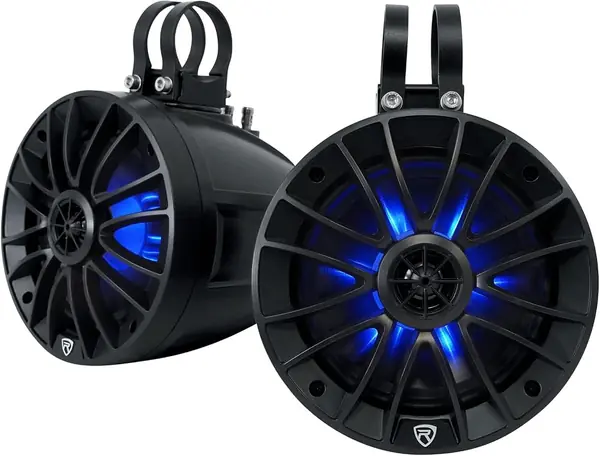
Two speakers instead of one bar is the whole idea here, and it changes what you hear. The PT65BR kit is a powered master pod and a passive slave, each with a 6.5-inch true coaxial driver, joined by a 6.56-foot run of speaker wire. Bolt one to each side of the cage and the music arrives from two directions instead of a single strip above the dash, which is the closest thing to a stereo image you will get on an open machine.

Each pod rides an adjustable swivel bracket with hardware for 1.5-, 1.75-, 1.85-, and 2-inch bars, so you can angle them at the seats rather than straight back at the horizon. There is no separate amplifier to buy or find room for: the master carries the Class-D amp, Bluetooth at 33 feet, a 3.5mm input, and an RCA output. IPX6 and full marination put salt spray and lake water inside the spec, which is more than most bars here promise.

Where the money goes is headroom. The 100-watt RMS rating means the amplifier is not straining at the volume you actually ride at, and the sound stays composed instead of hardening as it gets louder. Where it asks something back is the install: two pods, a wire run between them, and clamps that take a firm hand to sit snug. On a Jeep cage or a wide machine with shoulder room, that is a fair trade for the soundstage.

Pros

  • Two aimable pods give real stereo separation
  • 100 watts RMS means headroom at riding volume
  • IPX6 and fully marinized for salt and spray
  • Swivel brackets fit 1.5- to 2-inch bars

Cons

  • Two pods mean a wire run between them
  • Clamps take effort to tighten snugly
Our verdict

Choose this pair when stereo spread and amplifier headroom matter more than a single tidy bar above the dash.

Check Latest Price
5

KORBROS 17-Inch UTV Sound Bar Best Budget Bar

63 /100
TKZ Score Good

Key details

Peak Power
400 watts
Bar Length
17 inches
Roll Bar Fit
1 to 2 inches
Weather Rating
IP66
View on Amazon

This is the bar we point to when the budget does the deciding. Seventeen inches, four drivers, IP66, a 400-watt peak rating, and clamps that fit 1- to 2-inch cages put it in the same territory as our top pick. What it does not carry is the Ehaho's Auracast pairing or its reach: Bluetooth 5.0 here, at roughly 33 feet, and one bar per phone.

For a first sound bar on a working machine, that trade is sensible. At seven pounds it moves between a UTV and a golf cart without a fight, the top-or-bottom mount is forgiving of an awkward cage, and the 4-inch full-range drivers with soft-dome tweeters get over the engine rather than through it, which is the thing cheap bars usually fail at. The control panel and the remote both do what they say, and the aux input is there for the days Bluetooth gets crowded.

It is a 17-inch bar, though, and it sounds like one. The stage is narrow, and at wide-open throttle a bigger unit simply has more to give, so if your rides are fast and long, spend more. For yard work, trailheads, and the occasional parade, this has plenty left.

Pros

  • IP66 sealing and 400-watt peak at a budget price
  • Brackets fit 1- to 2-inch cages
  • Seven pounds, so it moves between machines

Cons

  • Bluetooth 5.0 with a roughly 33-foot range
  • No multi-bar pairing
Our verdict

A sensible first sound bar: sealed to IP66, seven pounds, and cheap enough to move from machine to machine.

Check Latest Price
6

Ehaho Rumble-X 30-Inch Sound Bar Best for Large, Loud Machines

62 /100
TKZ Score Good

Key details

Peak Power
500 watts
Bar Length
30 inches
Roll Bar Fit
1 to 2 inches
Weather Rating
IP66
View on Amazon

Thirty inches of aluminum with eight drivers inside: this is the bar for a machine that has the width and the noise to justify it. Ehaho spreads two 4-inch subwoofers, two low-frequency radiators, two midrange drivers, and two tweeters along the length of it, then adds a Voice EQ mode aimed squarely at the oldest problem in off-road audio, which is hearing a vocal over a wound-out engine and a headwind.

The remote is radio-frequency rather than infrared, so it works from the driver's seat with gloves on and without line of sight; volume, track, EQ, and the light shows all live there. Fourteen lighting modes, an aluminum housing that sheds heat better than the plastic bars in this group, IP66 sealing, color-coded wiring, and no-drill clamps for 1- to 2-inch cages round out a package that reads like it was designed by people who ride.

Our reservation is the footprint, and it is not a small one. A 30-inch bar needs a clear span above the dash; on a compact machine it will crowd either your sightline or your headroom, and at close to 20 pounds it is the heaviest thing on this page. Give it the room and the dedicated midrange is what sells it, because vocals sit forward in the mix in a way the smaller bars cannot match.

Pros

  • Eight drivers with dedicated midrange for vocals
  • Voice EQ targets wind and engine noise
  • RF remote works from the driver's seat, gloves on

Cons

  • Thirty inches needs a wide, clear span
  • Heaviest bar here at close to 20 pounds
Our verdict

We reach for it when the machine is big and the engine is loud; the voice EQ and the RF remote justify the footprint.

Check Latest Price

How We Tested UTV Bluetooth Speakers

We built the shortlist by researching what actually clamps to a side-by-side cage: bar lengths, clamp ranges, sealed housings, and whether a unit taps the machine's own 12-volt bus or needs a dedicated power run. That filtered down to 12 units, from a 6.5-inch single pod to a 30-inch bar with eight drivers, tested over eight months.

Installation came first. I mounted each bar solo with hand tools and timed it, checking the clamps against 1.5-, 1.75-, and 2-inch cage tubing to see whether they gripped bare or needed shims, then routed the power lead and hid the wiring. I noted which ones demanded a second set of hands, which clamps scuffed the powder coat, and which bars were still tight after a month of washboard roads.

Then we rode the same loop with every unit: gravel washboard at 25 mph, a rocky two-track, a creek crossing deep enough to dunk the housing, and a night run. Volume was set once at the start so I could hear which bars went thin when the engine loaded up and which kept vocals and bass intact. Back at the trailer I hosed each one down and looked for water behind the lenses and in the ports.

Bluetooth got its own abuse — pairing to a phone, a tablet, and a second rider's phone, then killing the ignition mid-song to see which bars reconnected on their own and which needed a manual press. I worked every remote with riding gloves on, from 20 feet behind the machine, and logged which buttons you could find by feel and how quickly each unit drew down a battery on a long day.

How to Choose a Bluetooth Speaker for a Utv

Start With the Cage, Not the Speaker

Every SxS sound bar on this page clamps to the cage, so the tube diameter is your first measurement. Clamps in this group run from 1 inch to 2.25 inches, and the difference is not academic: a 1-to-2-inch bracket will not close on the fat tube of a Can-Am or a newer RZR, and a 1.56-to-2.25-inch bracket rattles on a thin one. Overhead roof units clamp between two parallel tubes, so measure that span as well. On a quad with no round tube at all, a ratchet strap is the practical answer.

Loud Enough at Riding Speed Is the Only Spec That Matters

Peak wattage claims on these bars run from 80 to 700, and they do not line up across brands. A 160-watt bar with four real woofers can outpunch a 400-watt bar with two small drivers, so treat the number as a hint rather than a ranking. What counts is whether the music survives a loaded engine. Test at your normal trail speed with volume around 70 percent. Pinned at maximum and still missing lyrics means the bar is undersized for your machine, and a helmet cuts the highs before it cuts anything else.

Sealing: IP66 Is the Number to Look For

IP66 covers dust and hose-pressure water, which is exactly what a muddy ride and a wash-down demand, and IP65 is close enough for rain. Water repellent and IPX6 describe splash resistance rather than a sealed housing, so a PVC-bodied bar sold that way is for dry-weather riders. Two details undo a good rating anyway: the power plug and the fuse holder. Mount both high and out of the splash line, and pack the connectors with dielectric grease before the first wet season rather than after it.

Wiring: 12 Volts, a Fuse, and a Switched Circuit

Every unit here is a 12-volt DC device, and most arrive with a cigarette-lighter plug. That is fine for a weekend install, but a plug works loose on washboard and its only protection is the fuse inside it. Hardwire to a switched circuit through the supplied inline fuse so the bar dies with the ignition and cannot flatten the battery. On an electric golf cart, fit a 36- or 48-volt-to-12-volt reducer first; feeding a 12-volt bar from the pack directly will end it.

Controls You Can Reach With Gloves On

Decide up front whether you will run the bar from buttons on the housing, a remote, or a phone. Infrared remotes need line of sight and are useless behind a windshield with sun on it; radio-frequency remotes work from anywhere in the cab, which is the difference between changing a track and stopping. Check that the remote can power the unit on, not just adjust it, because some cannot. An app is a nice extra for light shows and a poor volume knob when your hands are full.

Frequently Asked Questions

Final Verdict

If you want one safe buy for a general trail machine, the Ehaho 17-inch is it: audible over a loaded engine, sealed to IP66, quick to bolt on, and covered by a two-year warranty. Most riders will never need more bar than that.

Spend up only when a requirement pulls you there. The 28-inch KEMIMOTO if low end and a wide cage fit come first, the Rockville pair if stereo spread matters more than simplicity, the strap-mounted KEMIMOTO if your machine has no cage to clamp to, and the 30-inch Ehaho only if you have the clear span above the dash to fit it.