Best Bluetooth Speakers for the Car of 2026

The worst part of an old car isn't the mileage—it's the stereo. My first car's CD player skipped over every bump, so I spent years burning mixes I couldn't hear over road noise. A portable Bluetooth speaker won't fix the transmission, but it can give you streaming music and enough volume to drown out a worn-out exhaust without a trip to the install bay. The catch is that a speaker built for a picnic isn't automatically built for a cup holder: it has to be loud enough at highway speed, small enough not to crowd the console, and tough enough to survive being kicked under the seat.

Over the past six months, I've lived with 15 of these speakers in my car—on commutes, road trips, and driveway wash sessions—while my team compared sound, volume, Bluetooth stability, battery life, size, and value. I paid attention to the extras shoppers compare: waterproofing, stereo pairing, what comes in the box, and whether the light show is fun or distracting at night. The ones worth buying disappear until you want music.

The Best Bluetooth Speakers for the Car

1

JBL Flip 5 Best Overall
96 /100
TKZ Score Outstanding

Key details

Playtime
Up to 12 hours
Waterproof Rating
IPX7
Output
20 watts
Dimensions
7.1 x 2.7 x 2.9 in
View on Amazon

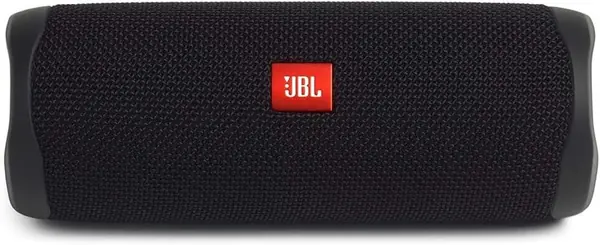
A Flip 5 is about the size of a big water bottle: 7.1 inches long, 2.9 inches across, 1.2 pounds. That measurement is the whole reason it works in a car. It drops into a cup holder, wedges into a door pocket, or lies across the console, and it comes back out in one hand when you park. Nothing gets installed, nothing gets wired into a dashboard, and nothing rattles loose on the first hard stop.

Twenty watts in a body that size is the part we keep coming back to. A car is a hostile listening room, full of hard plastics, tire roar, and a window cracked at speed, and the Flip 5 climbs over that noise without the strained, shouty edge you hear from cheaper speakers pushed to their limit. Bass has real weight behind it, and IPX7 means rain through an open window or a coffee tipped on the seat is not a disaster.

Where it gives ground is charge. Twelve hours is the shortest playtime among the mid-size speakers here, and some units eventually stop accepting a charge: the speaker still plays, the port stops taking power. Keep a USB-C cable in the glovebox, top it up between trips rather than running it to zero, and buy somewhere with a return path. Twelve hours of driving is still a week of ordinary use.

Pros

  • 20 watts that carry over road noise
  • Bottle-sized body fits a cup holder
  • IPX7 sealing for a car that parks outside

Cons

  • Charging can stop working on some units
  • 12 hours is short next to the 24-hour picks
Our verdict

We recommend the Flip 5 first for most cars: 20 watts that carry over road noise, IPX7 for weather, and a body that lives in a cup holder.
Check Latest Price
2

JBL Charge 6 Best for Big Sound

95 /100
TKZ Score Outstanding

Key details

Playtime
Up to 24 hours
Waterproof Rating
IP67
Output
45 watts
Weight
2.2 lb
View on Amazon

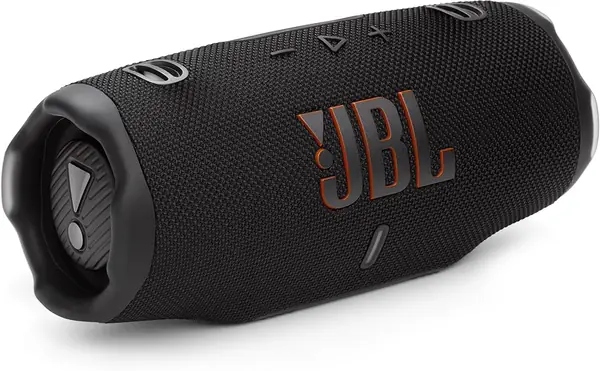
Nine inches long, 2.2 pounds, and shaped like a small torpedo, the Charge 6 is the one that will not sit in a cup holder. It rides on a passenger seat or in the well of a console, and the removable strap makes it easy to grab on the way out of the car. If you want a speaker that disappears into the cabin, this is not it.

What the size buys is headroom. Forty-five watts is the most power in this group, and the low end is genuinely deep, deep enough that the bass line rather than the vocal is what you notice first. IP67 covers dust and a dunking, Auracast pairs a second Charge 6 for stereo, and the built-in powerbank is the feature that changes a road trip: your phone charges off the speaker instead of hunting for a 12-volt adapter.

For a long drive we take the Charge 6 and leave the small ones home, because the weight buys volume and a battery that keeps going after everyone else's has quit. Two things to know going in. The box holds a strap and paperwork but no charging cable. And the battery is the shakiest part of the story, with some units running well short of the 24-hour claim, so buy where you can exchange it.

Pros

  • 45 watts with genuinely deep bass
  • Built-in powerbank charges a phone
  • IP67 with up to 24 hours of playtime

Cons

  • Needs a seat, not a cup holder
  • No charging cable in the box
Our verdict

If volume and playtime matter more than footprint, we point you to the Charge 6: 45 watts, IP67, and a powerbank built in.

Check Latest Price
3

Bose SoundLink Flex (2nd Gen) Best for Staying Put

94 /100
TKZ Score Outstanding

Key details

Playtime
Up to 12 hours
Waterproof Rating
IP67
Output
7.5 watts
Bluetooth Range
30 feet
View on Amazon

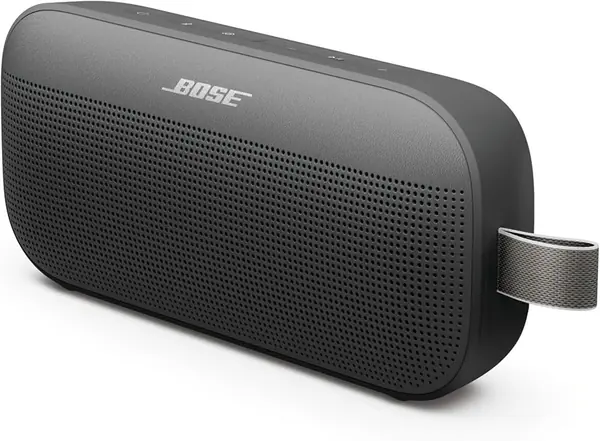
The Flex's most useful trick in a car is not sound, it is the silicone. The body is wrapped in a soft rubber shell with nothing to skid on, so it sits on a leather seat, a plastic console lid, or a rubber mat and stays there through a corner taken faster than you meant. Of the speakers here, it is the one we trust to ride loose rather than be wedged into place.

It also sounds better than 7.5 rated watts suggests: balanced and clear, with real bass at moderate volume, which is where most car listening happens. What it does not do is get loud. Push it and it tops out earlier than the Flip 5 or the Charge 6, so on a highway with the windows down you will meet the ceiling. At normal speeds inside the car, it is the most pleasant of the small speakers to listen to.

Everything else is sensible: IP67, twelve hours, USB-C charging, a utility loop for clipping it to a bag, and stereo pairing with a second Bose speaker. Bluetooth range is about 30 feet, the shortest here, though in a car you are never more than a few feet away. It also costs more than the more powerful Flip 5, which is the honest trade: you are paying for the sound and the grip, not the wattage.

Pros

  • Rubberized body grips a seat instead of sliding
  • Balanced, clear sound for its size
  • IP67, USB-C, and 12 hours of playtime

Cons

  • Maximum volume trails the louder picks
  • Costs more than the more powerful Flip 5
Our verdict

We trust the Flex to stay where you set it, and it is the small speaker we reach for when sound quality matters more than raw volume.

Check Latest Price
4

Anker soundcore 2 Best Budget

92 /100
TKZ Score Outstanding

Key details

Playtime
Up to 24 hours
Waterproof Rating
IPX7
Output
12 watts
Weight
14.6 oz
View on Amazon

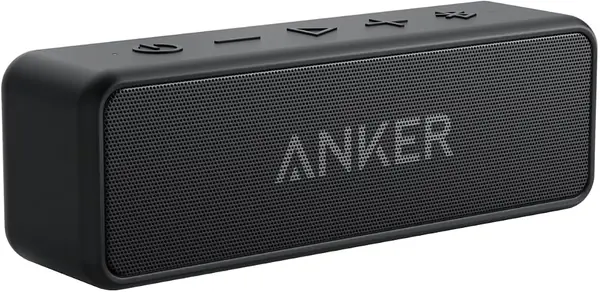
Twenty-four hours is the number that matters here. The soundcore 2 runs on a 5,200mAh battery, recharges in about three hours, and measures 6.5 by 2.1 by 1.8 inches, small enough to sit in a console tray and be forgotten about. IPX7 means a car that parks outside is not a problem.

We treat it as the value answer. Twelve watts and dual drivers will not fill a stadium, but they carry a podcast or a playlist over city traffic without distorting, and BassUp puts some weight into the low end at lower volumes. Nothing here is fancy, which is the point: no app, no light show, no strap. An 18-month warranty covers the stretch when an inexpensive speaker usually gives up.

If you drive at highway speed with the windows down, spend more, because the Flip 5's extra eight watts are audible and so is the Charge 6's forty-five. If your car time is a commute, school runs, and the parking lot before practice, the soundcore 2 does the job and you will charge it about once a month.

Pros

  • 24 hours of playtime per charge
  • IPX7 sealed and small enough for a console
  • 18-month warranty at a budget price

Cons

  • 12 watts runs out of headroom at highway speed
Our verdict

We keep the soundcore 2 for the driver who wants a full day of playtime, IPX7, and nothing to think about in an older car.

Check Latest Price
5

CHIFENCHY PulseSound Best Cup-Holder Fit

91 /100
TKZ Score Outstanding

Key details

Playtime
Up to 15 hours
Waterproof Rating
IPX5
Output
15 watts
Dimensions
2.99 x 2.99 x 4.25 in
View on Amazon

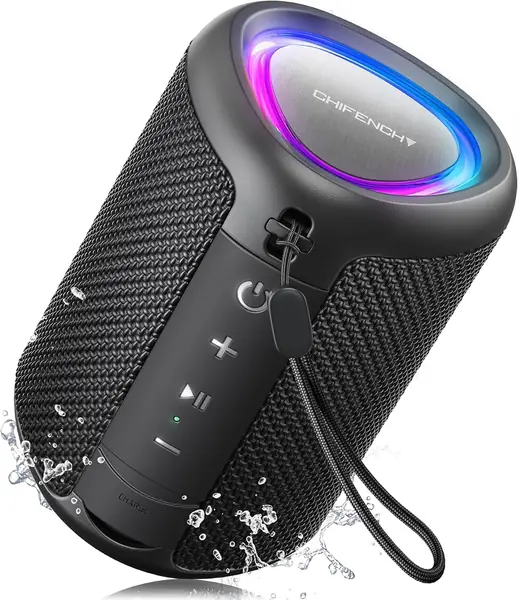
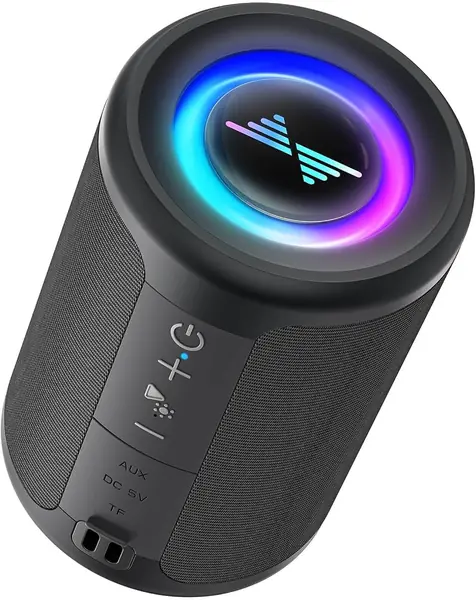
At 2.99 inches square and a little over four inches tall, the PulseSound is built like a cup-holder insert. Drop it in and it stands upright with the driver facing the cabin instead of firing into a seat cushion, which is more than most speakers here can manage.

The rest of the package is broader than the size suggests: 15 watts, Bluetooth 5.3 with a listed 100-foot range, 15 hours of playtime, IPX5 sealing, a lanyard, LED rings you can switch off, a built-in mic for calls, and an AUX input for a car with a headphone jack and nothing else. It weighs about as much as a phone.

What we like is how little it asks of you. One charge covers a week of commutes, the buttons are big enough to find without staring down for long, and it needs no case and no mount. The catch is IPX5, which means splashes rather than a dunking, and a six-month warranty that is the shortest of any pick here. In a car neither matters; beside a pool, both do.

Pros

  • Cup-holder footprint that stands upright
  • 15 hours per charge with a long Bluetooth range
  • Built-in mic and an AUX input

Cons

  • IPX5 only, so no dunking or heavy rain
  • Six-month warranty is the shortest here
Our verdict

The PulseSound is what we hand someone whose cup holder is the only free space: 15 watts, 15 hours, and a footprint that fits.

Check Latest Price
6

BassBloom ROAR 3 Drivers Who Want to See the Charge Level

90 /100
TKZ Score Outstanding

Key details

Playtime
Up to 24 hours
Waterproof Rating
IPX6
Weight
1.06 lb
Battery Display
Percentage readout
View on Amazon

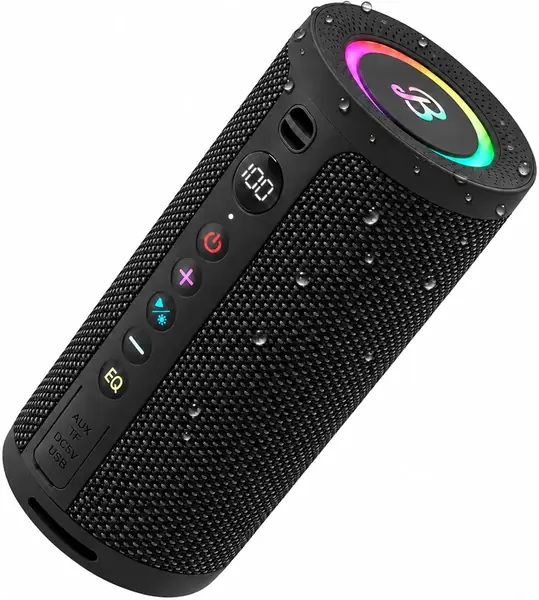
A percentage readout is a small feature that changes how a speaker lives in a car. Instead of guessing whether the ROAR 3 has an hour or a day left, you glance at the number and decide whether to carry it inside. That display is what we noticed first, and it is the reason this one stays in the conversation.

Underneath it is a sensible package: 480 grams, 7 by 3 by 3 inches, Bluetooth 5.4, IPX6, TWS pairing for a second unit, RGB rings, dual EQ modes, and a 24-hour playtime claim that is not the weak spot it turns out to be on several speakers here. It is bass-forward by design, which suits a car, and the readout means you are rarely caught with a dead battery.

Two reservations. IPX6 handles jets and rain but not a dunking, so treat it as a fair-weather car speaker. And BassBloom is the least-known name in this group, which is the honest reason it sits in also-consider rather than a top slot. If the readout is the feature you want, though, nothing else here has it.

Pros

  • Percentage battery display
  • 24-hour playtime that mostly holds up
  • Light enough to carry with a strap

Cons

  • IPX6 stops short of a dunking
Our verdict

The ROAR 3 earns our nod for the percentage readout: 24 hours, IPX6, and no guessing about charge before a drive.

Check Latest Price
7

dbsono N7A Best for A Glovebox Backup or Second Car

88 /100
TKZ Score Excellent

Key details

Playtime
Up to 24 hours
Waterproof Rating
IPX5
Output
10 watts
Inputs
Bluetooth and AUX
View on Amazon

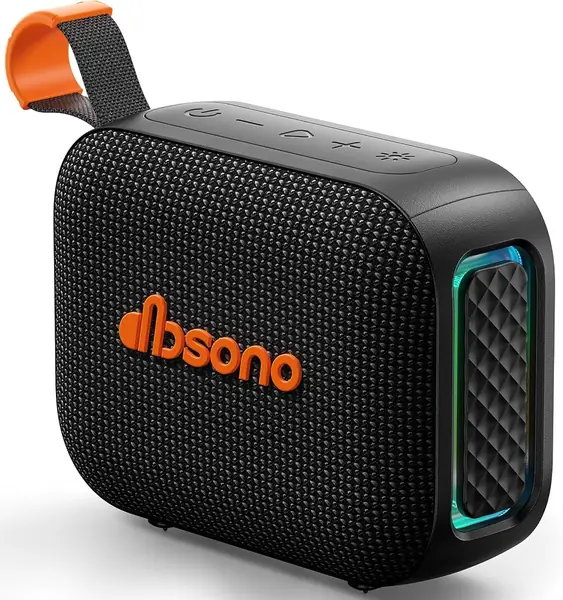
Eleven ounces, 4.5 inches wide, and shaped to slide into a glovebox, the N7A is the speaker you keep in the car and forget about until you need it. dbsono lists it for car, bus, and motorcycle use, and the size is why that claim holds up.

Ten watts goes further than the number suggests in a small cabin. At moderate volume it is clear, with enough bass to keep music from sounding thin, and the 24-hour figure assumes low volume with the lights off, which is roughly how it gets used in a car anyway.

Bluetooth pairing is straightforward, there is an AUX jack for a head unit older than the phone, and two units pair for stereo. Listed range is 33 feet, more than a car needs. Push the volume toward the top of the range and it thins out and loses clarity, a limit you will meet on a highway and rarely in traffic.

We keep it in the roundup because it does the basic job for very little money, and because a second car or a work van does not need better. If how the music sounds is the point, the step up to the Flip 5 is the better spend; if the point is having something that plays, this is enough.

Pros

  • Light enough to live in a glovebox
  • AUX input plus TWS stereo pairing
  • Clear at moderate volume with all-day playtime

Cons

  • Thins out and loses clarity near maximum volume
Our verdict

For a glovebox backup or a second car, we recommend the N7A: light, AUX-ready, and inexpensive enough to leave in a door pocket.

Check Latest Price
8

LENRUE FA02 Old Cars with a Working AUX Jack

87 /100
TKZ Score Excellent

Key details

Weight
0.66 lb
Inputs
Bluetooth, AUX, TF card
Charging
USB-C
Bluetooth
5.3
View on Amazon

A 1.5-inch column, 4.5 inches tall, two-thirds of a pound: the FA02 is shaped like something that belongs in a cup holder, and that is where it ends up. It also carries more inputs than anything else here, with Bluetooth 5.3, an AUX jack, and a TF card slot for music stored offline.

Around that are the extras: a light ring and a backlit logo, a detachable lanyard, USB-C charging, and TWS pairing for a second unit. There is no water-resistance rating at all, so it stays out of the rain and off a wet seat.

The 30-watt figure is generous for a speaker this size, and the honest read is a low-volume speaker: fine for talk radio, podcasts, and background music, strained once bass arrives. Connection is the other soft spot, since pairing is quick when it works and a unit that will not hold a link is the failure to watch for. Buy from somewhere that takes returns.

We see it as the emergency option, the speaker you buy when the car has an AUX jack, the budget is fixed, and something has to play. It is genuinely good on a desk or a workbench too. It is not the one to buy if you want to hear bass over road noise.

Pros

  • AUX, TF card, and Bluetooth 5.3 inputs
  • Slim enough for a cup holder at 0.66 lb
  • USB-C charging and TWS pairing

Cons

  • No water resistance at all
  • Distorts as bass comes in
Our verdict

Our pick for one narrow job: putting sound into an old car through AUX or a card slot near the bottom of the budget.

Check Latest Price

How We Tested Bluetooth Speakers for the Car

I started with a long list of current portable speakers, then cut anything that looked too tall for a console cubby, too heavy to carry in one hand, or too fragile to ride in a back seat. That left 15 models, which we tested over six months on commutes, road trips, and driveway wash sessions. Each speaker rotated through the cup holder, passenger seat, and glovebox so I could judge how it fit a real car rather than a showroom shelf.

For sound and volume, I drove the same stretch of highway with the windows cracked and stepped each speaker through low, medium, and maximum volume, listening for muddy vocals, distorted bass, and whether podcasts stayed clear over tire noise. For connectivity, I paired each to two phones with different operating systems, left the phone in a pocket and in the trunk, and switched between devices to see how often I had to repair. I also paired two of the same model where stereo pairing was offered, and at night I cycled the light modes to see if they reflected off the windshield or helped me find the speaker in a dark footwell.

Battery life got a stopwatch test: I charged each fully, ran a commute-and-errand loop at realistic volume, and noted how quickly the claimed hours fell apart once standby time was included. For size and portability, I checked whether each fit a cup holder or glovebox, carried it one-handed, and weighed it packed. For durability, I dropped each from seat height onto concrete, wiped up spills, ran waterproof models under a tap, and left them in a hot car for an afternoon, then checked for cracked corners, stiff buttons, and rattles. For value and the buying decision, I tracked what came in the box—charging cable, strap, mount—and whether it needed extras to work well in a car.

How to Choose a Bluetooth Speaker for the Car

Measure the hole you have, not the bag it fits in

Compact in a product listing means it disappears into a backpack, not that it fits your cup holder. A cup holder is roughly 3 inches across at the base, so a cylinder or column under that width, like the 2.9-inch Flip 5 or the 2.99-inch PulseSound, drops in and stands upright. Anything wider, such as the 9-inch Charge 6, needs a seat, a console well, or a floor cubby.

Before you shop, measure the cup holder and the console lid. It is the difference between a speaker that lives in the car and one that lives in the trunk.

Watts are a rough guide to surviving road noise

Rated output is not loudness on its own, since tuning and cabinet design matter just as much, but it is the one number you get before you buy, and in a car it tracks with whether a speaker sounds relaxed or strained. Under about 15 watts, expect something fine in traffic and thin at highway speed. Twenty watts and up is where a cabin starts to fill.

If most of your driving is windows-down freeway, buy power. If it is a school run and a parking lot, a 10-watt speaker and a podcast are plenty.

Playtime, and how you will top it up

Twelve hours sounds ample until the speaker actually lives in the car and gets used in parking lots, at lunch, and on the way home. The 24-hour models here buy you the freedom to stop thinking about charging, and a percentage readout, as on the ROAR 3, removes the guesswork entirely.

Whatever you choose, charge it indoors on a wall adapter and run it down and back up now and then instead of leaving it pinned at full.

Sealing buys you more than rain protection

IPX5 handles splashes and drizzle; IPX7 and IP67 survive a dunking and a spilled drink. In a car the more useful half of a good rating is dust, since grit works into drivers and buttons on a beach parking lot or a dirt road.

One caution that outranks all of it: do not leave the speaker on the dashboard in July. Heat is harder on a lithium battery than any puddle.

Inputs for a dashboard that predates Bluetooth

Every speaker here streams over Bluetooth, but a car with a headphone jack gives you a second path: plug in an AUX cable and skip pairing entirely. The PulseSound and the FA02 both accept one, and the FA02 adds a card slot for music stored offline.

Range figures of 30 to 100 feet rarely matter when the phone sits in the cup holder next to the speaker. What matters more is whether it reconnects by itself when you start the car.

Frequently Asked Questions

Final Verdict

For most cars, the JBL Flip 5 is the answer. It is loud enough to sit on top of road noise, it drops into a cup holder or a door pocket, and IPX7 means weather and spilled coffee are not a crisis.

Spend more only for a reason. The Charge 6 buys you 45 watts and a powerbank, the Bose SoundLink Flex buys grip on a seat and the most balanced sound of the small picks, and on a tight budget the soundcore 2 gives up volume and keeps the playtime.